Space
Shaping the Future of Space
UC San Diego advances research in space that helps people. Our research is expansive and focused on real-world impacts and solutions. Our faculty and researchers lead the way in astronomy and astrophysics as well as life science, engineering and planetary science research that utilizes space for experiments and imaging to protect lives on Earth.
The Next Era Is Here
From bold entrepreneurship and federal investment priorities to breakthroughs in space medicine, infrastructure and dual-use technologies, Space Day Forum 2025 showcased the ideas and collaborations shaping the next era of the space economy.
Protecting Lives on Earth, With Space
With innovative approaches to life-threatening diseases and natural disasters, UC San Diego researchers are making critical breakthroughs.
Why Is Space So Fascinating?
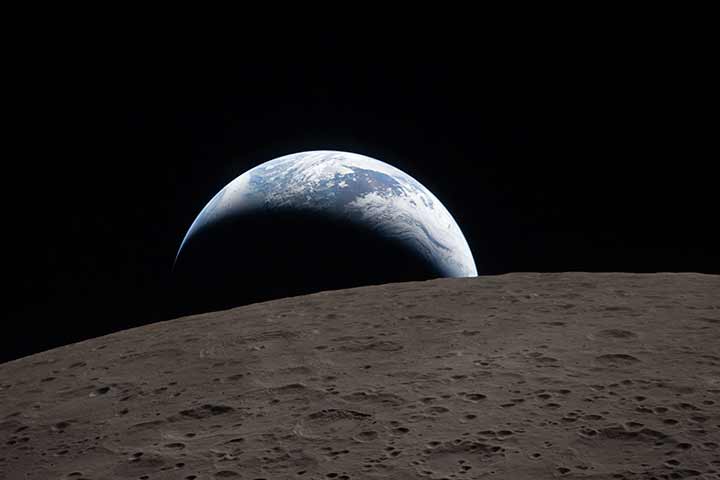
We all tuned in when the Artemis II crew splashed down off the San Diego coast. Planetary scientist and academic leader Meenakshi Wadhwa shares her thoughts on why space captures our imaginations so well.
Latest Space Breakthroughs and News
Seeing a Galaxy in New Detail
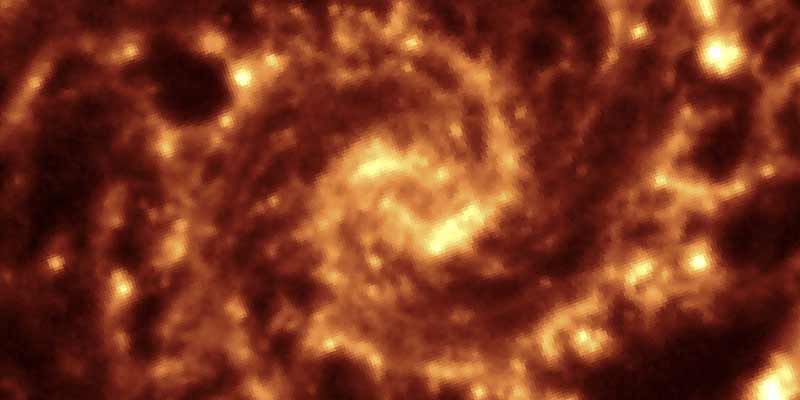
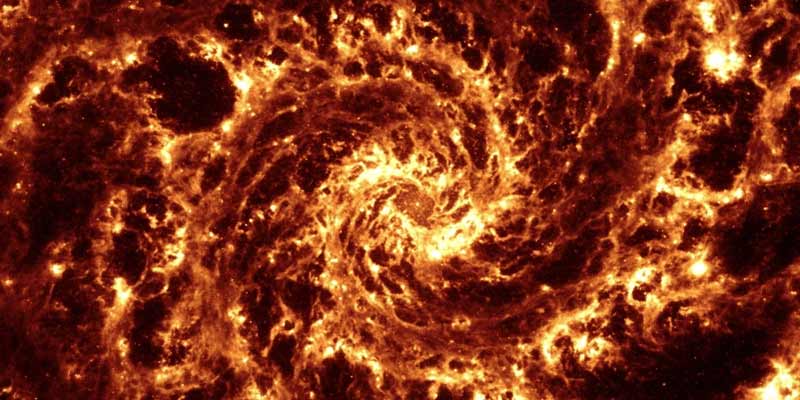
With recent advances in instrumentation, it is now possible for researchers to take more detailed images of nearby galaxies than previously possible — helping us better understand how new stars are born. A side-by-side comparison of NGC 628 (also known as the Phantom Galaxy) in images taken from the Spitzer Space Telescope in 2006, left, and the James Webb Space Telescope in 2024, right, shows the remarkable increase in clarity and detail that is now possible.
Space Experts
UC San Diego advances research in space that helps people.
Shelley Wright is a professor in the departments of astronomy & astrophysics and physics. She has spent her career building telescopes and instruments that pierce the veil of space, enabling the study of supermassive black holes, distant galaxies and the search for other life.
Catriona Jamieson, MD, is a hematologist, professor of medicine, chief of UC San Diego School of Medicine's Division of Regenerative Medicine and director of the Sanford Stem Cell Institute. Her research explores how space alters cancer progression.
Aaron Rosengren is a professor of mechanical and aerospace engineering. His work focuses on astrodynamics, orbital debris, applied and computational mathematics, chaotic and complex systems and more.
Helen Amanda Fricker is a professor of geophysics at Scripps Institution of Oceanography who was selected by NASA to lead a new satellite mission. Once completed and launched, the satellite will transform how scientists observe Earth’s land, vegetation, ice and coastal regions.
Alumna Jessica Meir Returns to Space — This Time as Commander
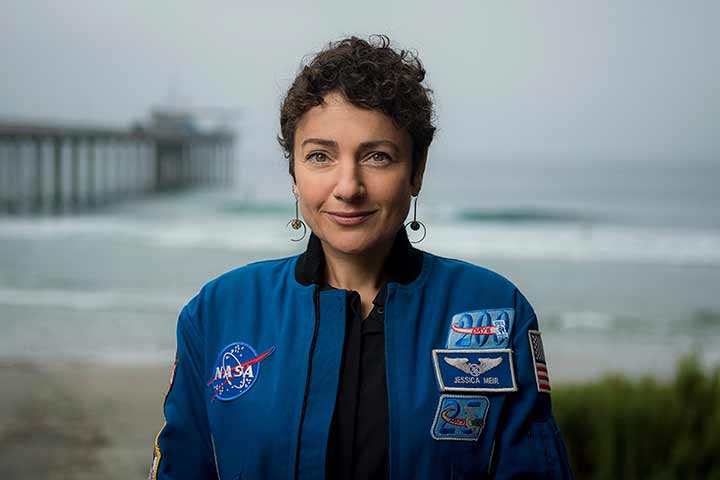
UC San Diego alumni are soaring to great heights in 2026 — including space! On Feb. 13, Scripps Institution of Oceanography alumna and NASA astronaut Jessica Meir embarked on her second journey to the International Space Station, serving as spacecraft commander for NASA’s SpaceX Crew-12 mission.
Space at UC San Diego
Department of Astronomy & Astrophysics
Created in 2023 to build upon a long and illustrious history of astronomy and astrophysics education and inquiry at UC San Diego, the department includes strengths in observational, experimental, and theoretical astrophysics. Faculty research spans from black holes and dark matter to the evolution of the universe, the formation of stars and the search for extraterrestrial life.
Sanford Stem Cell Institute
The Sanford Stem Cell Institute is a global leader in regenerative medicine with a dedicated focus on space-based research via its Integrated Space Stem Cell Orbital Research (ISSCOR) Center and Stem Cell Fitness and Space Medicine Center. The institute and its centers have sent numerous payloads to the International Space Station over the last decade, seeking to harness the power of low Earth orbit’s unique environmental conditions for the benefit of astronaut health — and that of humans on Earth.
Jacobs School of Engineering
From research advancing the use of plants to produce pharmaceuticals in space, to the mathematics of asteroid movements and planetary collision; from the development of new materials for telescopes and radiation-hardened electronics, to satellite cybersecurity, engineers and computer scientists across the Jacobs School of Engineering are tackling the toughest space challenges, and educating the next generation of technical leaders who will power this industry, from rockets to rovers.
Scripps Institution of Oceanography
One of the world’s most important centers for global earth science research and education, Scripps Institution of Oceanography leads remote sensing research that utilizes satellites to study Earth as well as focused research on planetary sciences. This includes the study of the solar system, planets and natural satellites, lunar samples, meteors and meteorites, asteroids, comets and more.